Follow the story of one teacher who strives to change lives one lesson at a time.
Secret Heroes (A Journalism Piece)
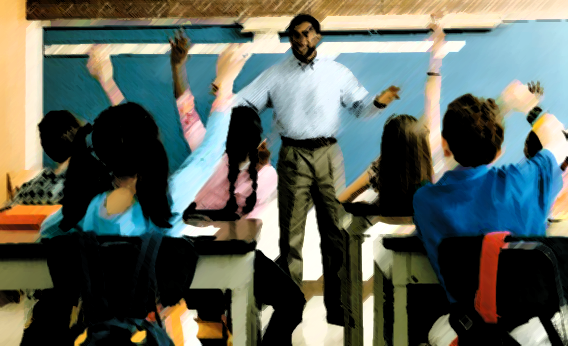
The national average starting pay for teachers in the United States is $36,141[1]. After graduating from an accredited university and carrying a piece of paper responsible for your devastatingly large debt, this is what you make. Depending on the state, school district, and whether it is a public or private school (private school teachers tend to make less), it is the criteria that determines a teacher’s wages. I would like to make clear, before I continue, that I believe that teachers deserve a living wage. Those who make a difference in the lives of children tend to be underappreciated—the emotional and even physical struggles of teaching in primary and secondary schools going unseen, because teachers are secret heroes.
I had the privilege of interviewing Dan C.[2], a middle school teacher here in Colorado Springs. His apartment is small, the kitchen being taken up by the double sink, fridge, and outdated gas stove. In his living room, there are several monitors placed meticulously around the place, with wires dancing along the edges of the white floorboards. His dining table takes up much of the space, pens, pencils, and markers placed in a holder along with Papa Murphy’s, Smash Burger, and Village Inn coupons. There’s also a bottle of clover honey sitting at the edge of his table, a book called Teach Like a Champion 2.0, the DnD Monster Manual, a Northlanders comic, copper wire, and other things that imply his various interests. Near the table is a large whiteboard scribbled with lesson plan ideas, to-do lists, and thoughts. He has a chair with a keyboard and several lamps near his many laptops and monitors. I sit down and wait for him to make himself some lemon tea.
I tell him that I’m ready to begin and he sits in a large leather chair, his work clothes from the school day still on—a nice buttoned up shirt and pants that have his work ID clipped to the belt loop. The monitor near his bedroom displays a PowerPoint presentation that I can’t make out, but am sure is for a lesson. We start recording and I ask him what he does.
“I am a middle school teacher…should I say where?”
“If you want,” I tell him. “I have to write everything you say, keep that in mind.”
Dan refrains from telling me the name of the middle school and continues: “I’m a computer literacy teacher, so…that means that I don’t have a curriculum and I just do my best to make children computer literate…and I have been teaching six through eighth grade for three years and have been working in middle school for the last six…always in the realm of technology and computers.”
I ask him why he wanted to become a teacher.
“Initially, it was like, I needed a career”—an uneasy laugh—“and I was in a situation where I had to get licensed as a teacher to get really into that career. But the more I started actually thinking about teaching and thinking about what kind teacher I would be, the more interested I got in education as a career. [I got into] education because all the goals I have in life surround education, being that my experience as a student was never[…well…]it was mostly negative until college[…] For the most part, I felt my education basically could’ve been done better and when I got to college, I figured I would grow out of that mindset, and when I became I teacher, I figured even [more so, but] it’s quite the opposite in that the more I learned about education, the more I feel that it’s just not my education that can be done better.”
I ask him what needs to change about education and after my clarification to be general, he tells me that we need to think of education in a different light. What is the purpose of education and what does it need to be? How should we all benefit? He then concludes that education is a lifelong journey and we need to talk about how we learn.
“What do you have to say about the low wages teachers are paid?” I ask him hesitantly. Conversations usually get interesting when you ask a teacher to give their take on wages. Dan seems to be ready for this question.
“I don’t think paying teachers better would make them better at their job,” he says. “And to some degree, it’s a fortunate thing that teachers aren’t paid better because then it means that you’re not going to get anyone in there that will care more about the money than the kids and the people. If you make everything about the money…well, we know how that went with our politics. I think that teachers are treated unfairly, comparatively, to other career paths because of the long hours, and I think that the real issue there is more in terms of who is paying attention[…] The actual fatigue, mentally, physically, emotionally, that goes into being a teacher [is never talked about], but at the same time, [you’re a teacher,] you don’t do your job to get compensation, [you teach to better] the human race. [The issue is more], how do we treat our teachers as a society and money is only a piece of that picture. And I go back to a time where you said, if teachers were treated like athletes in this country, then civilization would be better.”
I decided it was my opportunity to do a wage comparison, but my comparison to doctors is challenged when Dan brings up a valid point on who actually makes the money.
He directs it back to education: “The only people making money in education are not necessarily educators,” he states. “They work in policy and for companies that basically help devise and make the tests that students [and teachers] take.”
He has a point and I agree, despite being emotionally conflicted about his answer. I feel that maybe I made the question too broad and that the questions that followed put us off course.
I correct myself once he finishes talking: “I’m just saying…that teachers should be paid a living wage.”
Dan nods. “I agree, I mean, you’re in my apartment, so you know what I make. What I’m going back to is that we’re comparing things—yes, I think teachers should be paid better so they can live healthy lives, but at the same time, I’m hesitant to really push that because I think the sacrifice that teachers make is part of the identity of a good teacher. ”
Dan stops there and silence resumes. I finally ask if he has any words of wisdom or final words before I end the interview.
He chuckles and takes a minute to think about it. “I think it would be…just…take a moment every day to think about who in your life has done something that benefited you whether they intended to or not. [Just by taking] that moment to reflect every now and then on how other people have helped you makes you better as a human being…not only caring for other people, but also helps you see potential in others.”
He ends the recording and I tell him to send it to me. I get up from the table and start to get my things, not saying a word about the interview. I simply thank him for his time. I don’t even tell him how much more I respect teachers for their willingness to do something for others despite how much of themselves they must invest. I find, the reward lies not in the need to make enough money, but in the differences they make in the lives of others.
In my mind, I think Dan C. is the true definition of a good teacher.
A secret hero.
 Isioma West